A Study in Art as Medicine: the Songwright’s Apothecary Lab
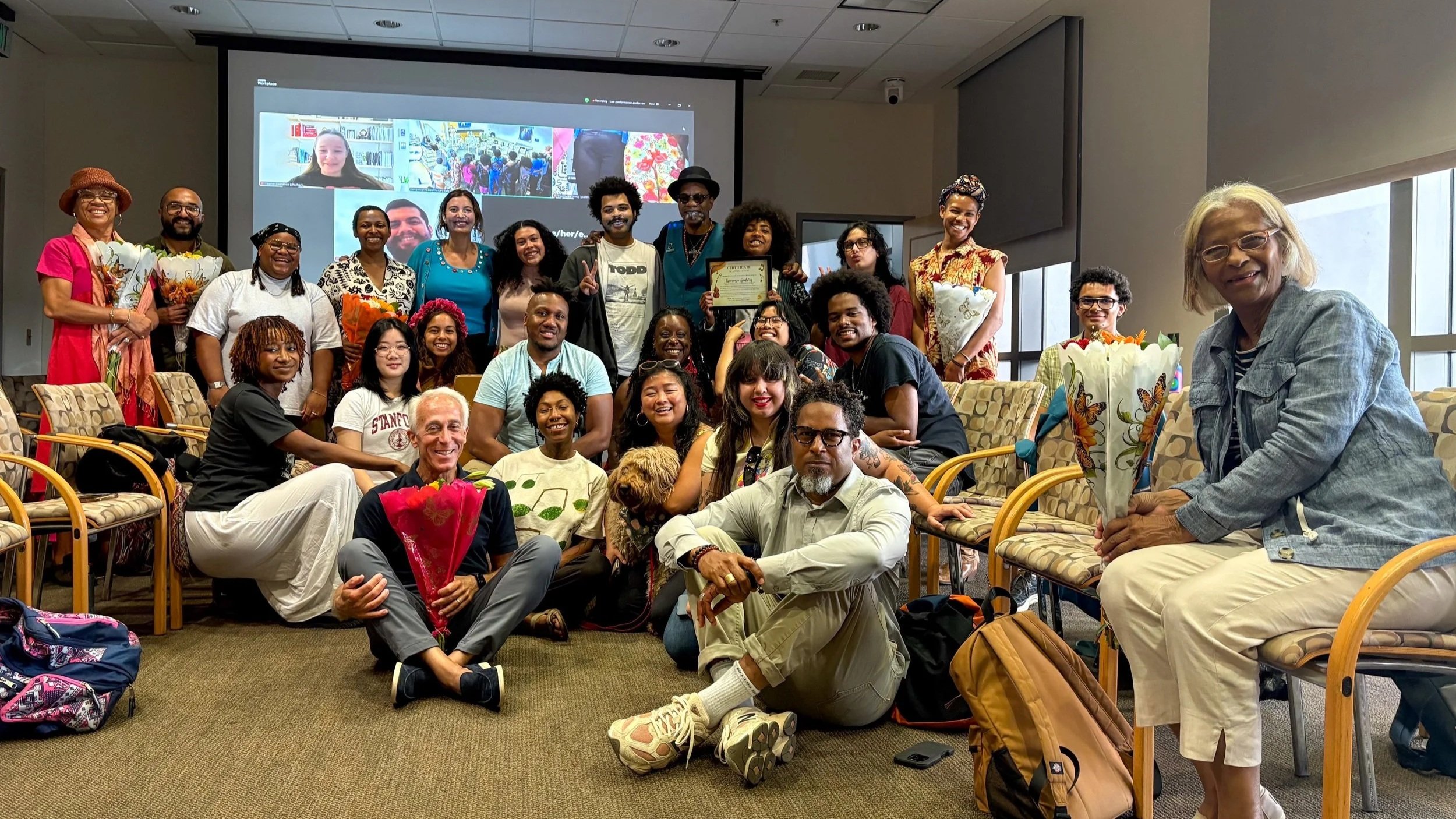
Have you ever thought about whether specific sound frequencies can be healing? Perhaps you’ve wondered if singing in unison with others can have both somatic and psychological benefits? Or if engaging in a rageful music experience could be cathartic? These are just some of the questions my classmates and I dreamed up and explored during our time in a small Lab this summer at UCLA. But this isn’t a lab you’ll come across in most university course listings. This was the Songwright’s Apothecary Lab and, frankly, there’s nothing else really like it.
Birthed from the curious and expansive mind of multi-instrumentalist musician, composer, storyteller, and scholar esperanza spalding, the Songwright’s Apothecary Lab is an exploration into the boundlessness of music’s ability to heal us in ways modern medicine and science don’t often recognize. A fully collaborative endeavor, the Lab is made up of students alternating between roles of songwrighter and researcher, a Council of experts in fields ranging from psychiatry to music therapy to neuroscience to ethnomusicology, and a supportive group of Research and Teacher’s Assistants, with Spalding pulling everything together as our creative director.
6 WEEKS, 3 UNITS
So, how does this work, exactly? How do you begin to answer these big, interesting questions? The 6 week course was broken up into three 2-week units, and at the beginning of each unit we were split into groups of about four people and had to decide what issue we would want to “tend to.” To help us decide, we used a human-centered design process led by Lab Research Assistant and IWES’ own Sr. Director of Media & Communications, Iman Shervington, to craft a research question centered on a need we want musick to address. In my first group of the lab, we decided to investigate how specific sound frequencies can alleviate symptoms of anxiety, trauma, and stress. To better understand where we could take that inquiry, our researcher began reviewing existing literature on the subject. At the same time, the songwriters drew inspiration from pre-existing musical works that embodied aspects of what we wanted to create in response to this question. Our researcher then shared her findings with the class, receiving questions and feedback from esperanza and the Council. Then we used that information to inform the composition of our musickal pieces. I personally was intrigued by our researcher’s mention of how frequencies of 250 Hz and below are traditionally used for sound healing. I was also interested in findings from a study where participants were exposed to various genres of music in an attempt to discern which ones might be more healing for them. It was noted that the silence they experienced in between the pieces was itself actually healing. Building on those two findings, I composed a piece that consisted of a constant 220 Hz frequency, a simple and repetitive, mantra-like bass melody, some light synth textures, and intermittent moments of “silence,” where the only audible sound was the frequency drone. After my fellow songwriters and I presented our works we received feedback from the Council, esperanza, and other attendees. Then it was back to the researcher to devise an evaluation tool to assess the efficacy of the musical intervention for those exposed to it. The last step was to bring it all together by presenting the musick and evaluation tool to the lab, simulating the process of how we would realistically administer and assess this musickal intervention in real life. I’m excited to share the first piece I created as I dove into this process; click on the audio player below to hear what I composed.
Each unit brought stimulating conversations around topics such as which biometric measurements might be best for specific evaluations, the role of ego in artistic processes, and how to avoid being extractive in our search for answers to these big questions by engaging in participatory research practices. I felt so grateful for the continuous feeling of excitement I had walking into class every day, anticipating what might come up in our discussions of the work we were doing. It was truly a space of openness, curiosity, safety, and exploration, a tone set and modeled with care and brilliance by esperanza herself. And if the community we built in our lab wasn't rewarding enough, we had the chance in our last week to share our experiences and creations with the larger LA community, as well. At the Earvin "Magic" Johnson Recreation Center, we had the opportunity to discuss our experiences and share our music with members of the community during “shareback sessions.” I got the opportunity to participate on a panel and speak about the process of creating my first song for the lab — shared above — and later played it for the room. During the Q&A, a guest shared that the song had a somatic effect on her and brought her to tears, and she thanked me for my work. That was an incredibly profound moment for me because it made real what I felt, that my song, this musical prescription of sorts, could do for someone.
In addition to the shareback panel, we also engaged in a community co-musicking session, devised and facilitated by esperanza and music therapist Dr. Marisol Norris — the co-creator of the S.A.L. and a member of the Council — as a way for us to deepen connection with each other, musicians and non-musicians alike, by creating music in real time that addressed a need brought forth by a group member. It was a truly magical and ethereal experience, a beautiful reminder that music is our birthright as humans, and we should all have the chance to experience what it's like to create it. And if all that wasn't enough, esperanza generously offered us time during her concert at the Music Center to share some of the pieces we created in the lab with the audience.
S.A.L. performance by Qu’ran Shaheed at the culminating concert at the Music Center
S.A.L. performance by Neyva Sandoval, Chis Powe, Brandon Smith, MsT Muse, and Ana Martinez at the culminating concert at the Music Center
When she asked if I would open the show with my frequency piece, I was both honored and nervous, not only because of the responsibility of starting things off that night, but also because it meant that I would technically be opening for the esperanza spalding, my teacher this summer, but also a bass hero of mine for years prior. It was an ending to this journey that I couldn't have predicted, but I was more grateful for it than I could have imagined.
Those six weeks of researching, songwriting, and evaluation yielded some of the most interesting works I’ve come across in my academic and musical career. My time at IWES has given me the chance to begin combining the worlds of music and mental health, and the Songwright’s Apothecary Lab has pushed that merger into a whole new and exciting lane. It was both a reminder of what I already knew to be true about music’s healing power and an introduction to new ways of thinking about and producing music that heals. My time as a member of the Songwright’s Apothecary Lab has transformed my artistry for the better, and I hope to help and inspire others the way my lab mates, Council members, RAs, TAs, esperanza, and the city of Los Angeles did for me.
S.A.L. performance of Dani Nalangan’s “Weather Song” with all participants at the culminating concert at the Music Center